Single-tank system · 9 L agent
CMJS9-1 Kitchen Fire Suppression System
Compact single-tank wet-chemical system for smaller cook lines. Protects up to 9 hazard units — one 600 mm fryer/wok per unit, or one 400 × 400 mm duct port per unit.
- 🔥 183°C fusible-link activation — no power needed
- ⏱️ Flame knock-down in 3–5 seconds
- 🚫 Automatic gas shut-off + sounder alarm
- 💧 Water cool-down cycle after discharge
- 📱 Optional smart-cloud alerts to phone/PC
USD 1,800 FOB per system, standard configuration · what that price includes
Technical Specifications
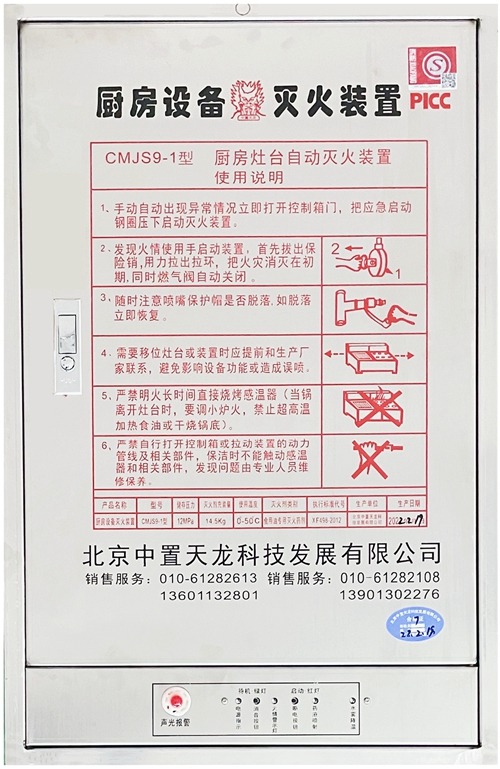
| Model | CMJS9-1 (single tank group) |
|---|---|
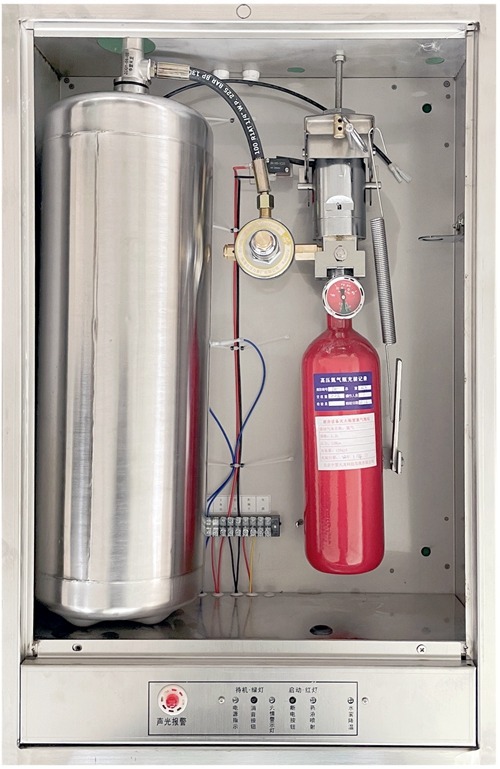
| Extinguishing agent | Potassium-acetate based wet chemical, 9 L |
| Propellant | Nitrogen cartridge (mechanical actuation) |
| Protection capacity | 9 hazard units — one Φ600 mm fryer/wok or one 400×400 mm duct port per unit |
| Activation | Fusible link, 183°C (manual / emergency pull as backup) |
| Extinguishing time | 3–5 seconds from discharge |
| Post-discharge cooling | Water valve opens automatically ~10 s after agent discharge |
| Fuel safety | Automatic gas-valve shut-off, audible-visual alarm, optional BMS/central-station link |
| Cabinet dimensions | 470 × 600 × 200 mm (W×H×D), wall-mounted |
| Power requirement | None (detection & discharge fully mechanical) |
| Smart monitoring | Optional cloud module — alerts to mobile app / PC terminal |
| Design standards | GA 498-2012 · GB 50016-2014 · CECS 233:2007 |
| Certification | CCCF fire-product certified (valid to Jun 2029); type-tested by the National Fixed Fire Extinguishing Systems QA & Test Centre |
Sizing guide
Each hazard unit covers one standard 600 mm fryer or wok station, or one 400 × 400 mm exhaust-duct opening. Count your appliances and duct ports, add 20% spare capacity for future line changes — if the total is 9 units or fewer, one CMJS9-1 is enough. Above that, step up to the CMJS18-2 dual-tank system.
1 fryer / wok ≤ Φ600 mm
= 1 hazard unit
1 duct port 400 × 400 mm
= 1 hazard unit
Not sure? Send the layout
We size it for you free of charge
What happens in the first 60 seconds
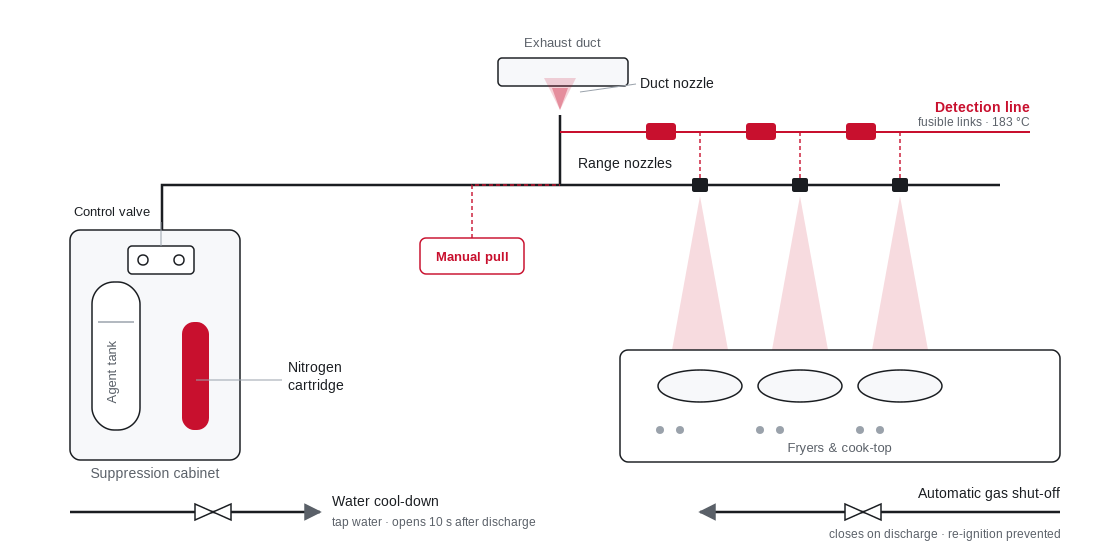
A cooking-oil fire doubles in size faster than a manual response can follow. The CMJS9-1 does not run its actions one after another — detection, discharge, gas shut-off, alarm and cool-down overlap, and the whole sequence is over in about a minute. The flame itself is out in 3–5 seconds.
1 · Detect at 183°C
A fusible link sits above every protected appliance and duct opening. At 183°C the link separates and releases the mechanical actuator. Normal cooking temperatures never reach it, so steam, smoke and spatter do not trip the system.
2 · Discharge in 3–5 s
The nitrogen cartridge ruptures the tank diaphragm and pressurises the 9 L of wet chemical. It leaves the nozzles as a fine mist at a steady pressure, so hot oil is not splashed out of the pan.
3 · Cut the gas
The same mechanical stroke closes the gas shut-off valve on the incoming line. Removing the fuel is what stops a wok fire from re-igniting after the agent has knocked it down.
4 · Alarm and notify
A local sounder and beacon run in the kitchen while a dry contact reports the discharge to the building management system or fire control room. Staff know instantly which kitchen has a problem.
5 · Cool with water
About 10 seconds after the agent finishes, the water valve opens and sprays the range and duct. Cooling the oil below its ignition point is what prevents the classic re-flash two minutes later.
Backup · Manual pull
Every installation includes a manual pull station at the kitchen exit, plus an emergency button on the cabinet. Both use the same discharge path as automatic activation.
What ships in the cabinet
The CMJS9-1 is supplied as a complete, pre-assembled system — not a tank that still needs half the components sourced locally. Nozzles are selected against your appliance list before shipment, so the pipe kit arrives matched to your cook line.
| Agent tank | 9 L potassium-acetate wet chemical, formulated for cooking-oil (Class F) fires. Non-toxic, odourless, and cleaned up with plain water. |
|---|---|
| Propellant | Sealed nitrogen cartridge. Stored pressure is released only at activation, so the tank is not under load while it waits on the wall. |
| Detection | 183°C fusible links on stainless-steel cable, one above each hazard unit and one at each duct opening. |
| Discharge | Atomising nozzles sized to burner diameter and duct-port area, plus a dedicated duct nozzle. Stainless steel, copper and alloy-aluminium pipework with anti-corrosion treatment. |
| Actuation | Mechanical control valve, manual pull station, emergency button on the cabinet front. |
| Interlocks | Gas shut-off valve link, water cool-down valve, sounder and beacon, dry contact for BMS or fire panel. |
| Monitoring (optional) | Cloud module reporting discharge, valve status and service dates to a phone app or PC terminal. |
Site requirements before you order
Four things on site decide whether a CMJS9-1 installs cleanly. Send photos of each with your inquiry and we will confirm the layout before the cabinet is built — this is the step that prevents most on-site surprises.
| Wall space | A clear wall area for the 470 × 600 × 200 mm cabinet, outside the direct splash zone of the range and within reach of the manual pull handle. The cabinet is wall-mounted and takes no floor space. |
|---|---|
| Gas line | An accessible shut-off valve on the incoming gas line that the system can close on activation. If the kitchen runs on LPG cylinders, tell us the arrangement. |
| Water line | A cold-water supply for the post-discharge cool-down cycle, with a valve the system can open. |
| Duct access | Each 400 × 400 mm duct opening needs a nozzle position and a service access point. Grease-filled ductwork without access cannot be protected properly. |
Retrofit is normal for this system: the work happens during a scheduled kitchen shutdown, and the range does not have to be removed. Typical installations are completed in a single day per cook line. Send your kitchen layout and we will return a nozzle plan and a bill of materials.
Which standard applies to your project
Kitchen suppression is one of the few product categories where the local standard decides what you are allowed to install. Being clear about this at inquiry stage saves months — so here is exactly where the CMJS9-1 stands.
| China — GA 498-2012 | The design, installation and acceptance standard for commercial kitchen cooking-area suppression. The CMJS9-1 is CCCF certified and type-tested by the National Fixed Fire Extinguishing Systems Quality Supervision and Testing Centre against this standard. |
|---|---|
| United States — NFPA 17A / UL 300 | NFPA 17A governs wet-chemical systems and UL 300 is the fire test that listing is based on. This model is not UL listed. If your project is specified to UL 300, tell us before design freeze and we will confirm what documentation we can supply. |
| Europe — EN 16282 / local codes | European projects generally require a CE-marked system under the applicable harmonised standard. The CMJS9-1 does not carry CE marking for this model; treat it as a China-standard system unless your consultant accepts CCCF documentation. |
| Middle East, Africa, Southeast Asia, Latin America | Many projects in these markets accept a CCCF-certified system with a full type-test report, or specify performance requirements rather than a named listing. This is where the CMJS9-1 is most often supplied. |
Full certificates, type-test reports and the manufacturer’s ISO 9001 / 14001 / 45001 documents are on the certifications page. We send the complete pack as PDF with every quotation, so your consultant or fire authority can review it before you commit. Unsure how CCCF compares with NFPA 17A or UL 300? The standards guide explains what each document governs.
CMJS9-1 or CMJS18-2?
| Hazard units protected | CMJS9-1: up to 9 | CMJS18-2: up to 18 |
|---|---|
| Agent volume | 9 L single tank | 18 L (2 × 9 L) dual tank |
| Cabinet footprint | 470 × 600 × 200 mm | 690 × 600 × 200 mm |
| Typical kitchen | Single outlet, café, small QSR, staff canteen | Hotel banquet kitchen, chain restaurant, central kitchen |
| Choose it when | Your count is 9 units or fewer with no planned expansion | You are at 10–18 units, or at 7–9 with a planned line extension |
Not sure which way the count falls? Read how a kitchen fire suppression system works first, then send us your appliance list — sizing is free and takes one working day.
Buyer questions on the CMJS9-1
How many fryers or woks can one CMJS9-1 protect?
Does it need mains power to work?
Will steam or smoke set it off?
Can it be retrofitted into an operating kitchen?
What has to be replaced after a discharge?
How is it maintained?
What do you need from me to quote?
Need the dual-tank version?
CMJS18-2 doubles the agent and protects up to 18 hazard units — built for full hotel and chain-restaurant cook lines.
View CMJS18-2