Price guide · 2026 · factory-direct
What a Kitchen Fire Suppression System Actually Costs
A wet-chemical system is priced per hazard, not per kitchen. The system itself is usually a quarter to half of an installed project — the rest is labour, duct work, interlocks and permits. Here is the full breakdown, so you can read a quotation line by line instead of comparing totals.
- 💰 CMJS9-1 USD 1,800 · CMJS18-2 USD 2,800 — FOB per system, published
- 🏠 S-1-D USD 50 · S-2-S USD 80 — per household unit, sealed and pre-charged
- 🏗️ Installed projects: roughly USD 3,500–12,000 for a single cook line
- 🔁 Semi-annual service: USD 175–350 per visit
- 📦 Factory-direct from China shifts the hardware line, not the local labour
The short version
You are buying coverage, not a box
Price follows hazard units — each fryer, wok, range or duct opening needs its own nozzle and its own share of agent. A 12-unit line costs roughly twice a 6-unit line in materials, and about 1.3× once labour is shared.
Cheap quotes are usually missing scope
Gas shut-off, duct protection, alarm contacts, commissioning and the acceptance test are the lines that get dropped. A quote 40% below the others is normally a system 40% smaller in scope.
Buying factory-direct moves one line only
Importing from the manufacturer cuts the system price. Freight, duty, local installation, permits and service stay local — that is why the saving is real but never 70%.
Where the money goes on an installed project
The table below is an indicative structure for a commercial cook line in North America or Western Europe, built from published 2026 contractor and distributor pricing. Treat it as a budgeting frame — your local labour rate and permit regime will move it.
| Line item | Share of project | Indicative range (USD) |
|---|---|---|
| System and nozzles (tank group, pipe kit, detection links, discharge nozzles) | 25–50% | 1,500–6,600 |
| Installation labour (piping, mounting, detection line, commissioning) | 25–35% | 1,500–6,000 |
| Hood, plenum and duct work needed to accept the system | 10–25% | 1,000–4,000 |
| Gas / electric shut-off interlock and valve | 5–12% | 500–1,200 |
| Permits, plan review and inspection | 5–10% | 300–1,500 |
| Alarm contacts, monitoring or BMS link (optional) | 0–8% | 150–900 |
Two consequences follow. First, the system is the smallest half of the decision — sizing it correctly matters more than shaving 10% off the unit price, because a system that is one hazard unit short gets re-quoted from scratch. Second, if you are supplying the hardware yourself, the money you control is that 25–50% line, and the local lines stay exactly where they were.
Our published price
| CMJS9-1 single-tank | USD 1,800 FOB per system — standard configuration, up to 9 hazard units |
|---|---|
| CMJS18-2 dual-tank | USD 2,800 FOB per system — standard configuration, up to 18 hazard units |
| Household S-1-D | USD 50 per unit — one thermal probe, one nozzle, 550 ml charge, one cooking zone |
| Household S-2-S | USD 80 per unit — two probes, two nozzles, 700 ml charge, two burners or a double wok |
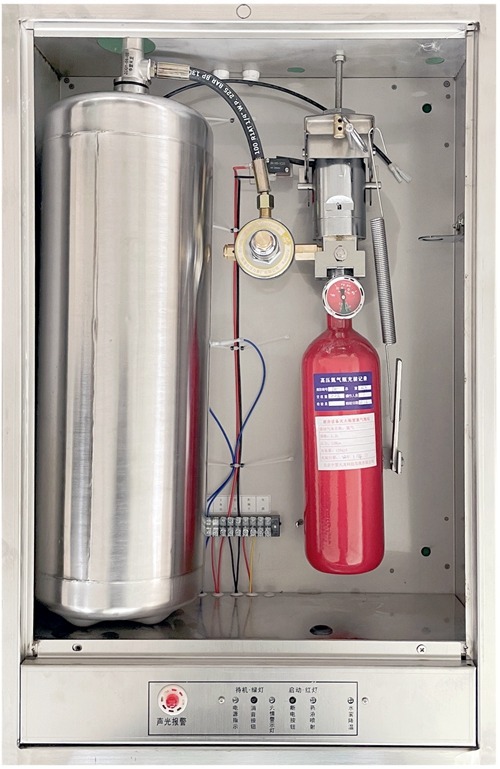
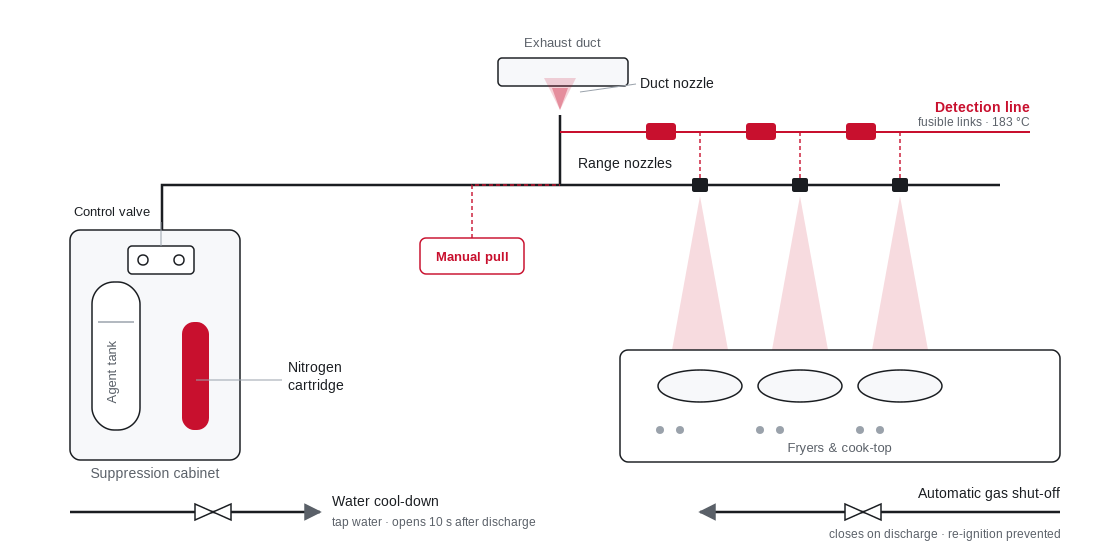
| In the price | Wall-mounted cabinet, agent tank, nitrogen cartridge, 183 °C fusible-link detection line, standard nozzle set, pipe kit, spare-link kit, installation drawing, commissioning checklist, CCCF certificate and national type-test report as PDF. |
| Outside the price | Nozzles beyond the standard set, long duct runs (quoted per metre), gas shut-off valve and linkage (quoted by valve type), sea freight, insurance, import duty, local installation, permits and the acceptance test. |
| Why we publish it | Both models have a fixed bill of materials, so there is nothing to hide behind a lump sum. What varies between kitchens is itemised as its own line instead of being absorbed into one number that grows at contract stage. |
| Wholesale | Container quantities price below these figures. Tell us the quantity and the destination port and we quote the lot on one sheet. |
These are FOB China prices, not installed prices: add freight, duty and your local contractor. Full specification for each model is on the CMJS9-1 and CMJS18-2 pages. Household S-series prices are per unit, not per project — one unit protects one stove, and both models ship as a sealed, pre-charged carton that needs no electricity or plumbing.
Six things that move the number more than anything else
| 1 · Hazard units | One 600 mm fryer or wok = one unit; one 400 × 400 mm duct opening = one unit. Nozzle count and agent volume both scale with this, so it is the first number to get right, and the first number a vague enquiry gets wrong. |
|---|---|
| 2 · Tank group step | Systems step, not slide. A CMJS9-1 covers up to 9 units on one 9 L tank; a CMJS18-2 covers up to 18 on two. Crossing a step adds a whole tank group, so a kitchen at 10 units costs noticeably more per unit than one at 9. |
| 3 · Duct and plenum length | Duct nozzles, detection links inside the duct and the length of pipe run are priced by the metre. A long horizontal run to a roof fan can add several hundred dollars of pipe, fittings and brackets on its own. |
| 4 · Shut-off interlock | Automatic gas shut-off is a safety requirement in every serious standard, and it needs a valve plus a mechanical or electrical link. Electric cooking ranges need a contactor instead. Skipping it is the most common silent omission in a low quote. |
| 5 · Access and retrofit hours | A new build with open ceilings installs in a day. A live kitchen with a tiled ceiling, a 4 m duct run and a night-only work window can double the labour line without changing a single part. |
| 6 · Freight, duty and destination | For an imported system, sea freight on a full tank group, insurance, import duty and port handling sit on top of the ex-works price. Nitrogen-pressurised components travel as dangerous goods (UN 1044), which is a documentation cost, not usually a large one — but it must be quoted. |
Why two quotes for the same kitchen differ by 40%
Put three quotations side by side and the totals will not agree. Nine times out of ten the gap is not margin — it is scope. Check these seven lines before you compare the bottom figure.
| Duct and plenum protection | A full quote covers the hood, the plenum above the filters and the duct entry. A trimmed quote covers only the appliances. |
|---|---|
| Nozzle count per appliance | Woks, char-broilers and griddles need appliance-specific nozzles and sometimes two per unit. A generic layout uses fewer nozzles than the listing requires. |
| Automatic fuel shut-off | Gas valve and linkage, or a contactor for electric ranges. Frequently listed as “by others” — which means it is not in the price. |
| Manual pull station | Required on the egress route, with the correct cable length. Cheap quotes fit it inside the cabinet where it cannot be reached in a fire. |
| Alarm and building interface | Sounders, visual alarm and a volt-free contact to the fire panel. Often excluded and then added as a variation. |
| Commissioning and acceptance test | A discharge test or a documented dry test with the authority having jurisdiction present. This is a day of skilled labour, and it disappears from low quotes. |
| Documentation pack | Certificate, type-test report, as-built drawing, commissioning record and a maintenance schedule. If your consultant asks for these later, they cost extra. |
Our own quotation lists every one of those seven lines as a numbered item, with the certification documents attached, so you can compare it against a local quote without guessing. See what ships with the system on the certifications page.
Factory-direct from China: what the price includes
We quote ex-works or FOB by default, because that is the only figure a manufacturer can control. Here is exactly where our responsibility stops at each Incoterm.
| EXW (ex-works) | System, nozzles, pipe kit, detection links, spare-link kit and documentation, packed for export at our factory. You arrange collection, export clearance and freight. |
|---|---|
| FOB (named port) | The same scope plus inland haulage to the port, export declaration and loading. This is the number to compare against another supplier’s FOB price. |
| CIF (named port) | FOB plus sea freight and marine insurance to your port. Duty and import clearance stay with you. |
| DDP (named place) | Delivered with duty paid, arranged through our forwarder. Only offered where the destination allows it and the broker is known to us. |
Not included at any Incoterm: local installation labour, local permits and inspection fees, unloading at site, and the licensed contractor your jurisdiction may require for commissioning. Budget those at local rates — they are the same whether the system comes from China or from a distributor 20 km away.
Ten-year cost of ownership
Purchase price is the smallest part of what a system costs over its life. These are the numbers that actually recur, at published 2026 service rates.
| Semi-annual inspection | USD 175–350 per visit, two visits a year. Covers link condition, nozzle caps, tank pressure, valve operation and the shut-off linkage. |
|---|---|
| Fusible links | USD 15–30 each, replaced at every semi-annual service because grease contamination changes the trip temperature. A 12-unit line carries 12–16 links. |
| Refill after a real discharge | Published claims for a recharge range from USD 500 to 4,000 for the same job, so ask your supplier for their refill price in writing before you buy. We quote it with the system. |
| Cylinder hydrostatic test | Every 12 years in most jurisdictions — a scheduled cost, not a surprise one. |
| Power | Zero. The CMJS series is mechanically actuated by a 183 °C fusible link and a nitrogen cartridge, so there is no standby power, no battery and no control panel to maintain. |
Over ten years the service and consumable lines typically equal or exceed the original purchase price. That is the strongest argument for buying a system whose links, caps and nozzles are standard parts you can restock quickly — which is why a spare-link kit ships with every unit.
How to get a firm number in 24 hours
Both CMJS models carry a published FOB price. What we do not publish is a single number for your kitchen, because a system sized to a guess is either oversized or non-compliant. Send four things and the quotation comes back the next working day, with the sizing shown.
Appliance list or plan
Burner count, wok diameters, fryer sizes, griddle and range widths. A photo of the cook line works if there is no drawing.
Duct openings
How many 400 × 400 mm duct ports, and how far the duct runs before it leaves the building.
Destination
Port or city, so we can quote FOB or CIF, and tell you which certification your market will accept.
Quantity matters too: a single system and a container of twelve price differently, and we will say so rather than wait for you to ask. Not sure how many units your line needs? Read how a kitchen fire suppression system works first, then send the plan — sizing is free.
Buyer questions on price
How much does a kitchen fire suppression system cost?
Why are these prices published?
Is a Chinese system cheaper than a local one?
What is the cheapest way to be compliant?
Do I need a gas shut-off valve in the quote?
What does a refill cost after discharge?
Can I install it myself?
Send four numbers, get a sized quotation
Appliance list, duct openings, destination port and quantity — that is all we need to return a system layout, a bill of materials and a price within one working day.
Request a Quote