Dual-tank system · 18 L agent
CMJS18-2 Kitchen Fire Suppression System
Full-size dual-tank system for demanding cook lines. Protects up to 18 hazard units — hotel banquet kitchens, chain-restaurant lines and central kitchens.
- 🔥 183°C fusible-link activation — no power needed
- ⏱️ Flame knock-down in 3–5 seconds
- 🚫 Automatic gas shut-off + sounder alarm
- 💧 Water cool-down cycle after discharge
- 📱 Optional smart-cloud alerts to phone/PC
USD 2,800 FOB per system, standard configuration · what that price includes
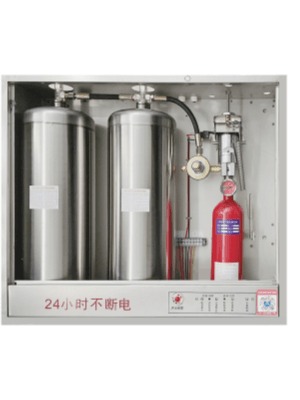
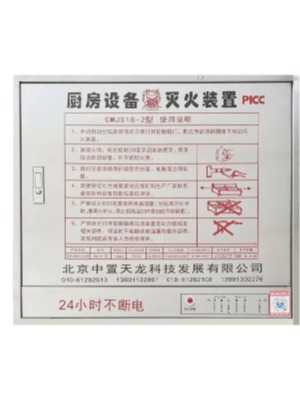
Technical Specifications
| Model | CMJS18-2 (dual tank group) |
|---|---|
| Extinguishing agent | Potassium-acetate based wet chemical, 18 L (2 × 9 L) |
| Propellant | Nitrogen cartridge (mechanical actuation) |
| Protection capacity | 18 hazard units — one Φ600 mm fryer/wok or one 400×400 mm duct port per unit |
| Activation | Fusible link, 183°C (manual / emergency pull as backup) |
| Extinguishing time | 3–5 seconds from discharge |
| Post-discharge cooling | Water valve opens automatically ~10 s after agent discharge |
| Fuel safety | Automatic gas-valve shut-off, audible-visual alarm, optional BMS/central-station link |
| Cabinet dimensions | 690 × 600 × 200 mm (W×H×D), wall-mounted |
| Power requirement | None (detection & discharge fully mechanical) |
| Smart monitoring | Optional cloud module — alerts to mobile app / PC terminal |
| Design standards | GA 498-2012 · GB 50016-2014 · CECS 233:2007 |
| Certification | CCCF fire-product certified (valid to Jun 2029); type-tested by the National Fixed Fire Extinguishing Systems QA & Test Centre |
Typical configurations
QSR line · 6–8 units
2 fryers, 2 ranges, 2 duct ports — CMJS9-1 covers it; CMJS18-2 leaves headroom.
Hotel line · 10–18 units
Banquet wok battery plus duct network — CMJS18-2 in one cabinet.
Central kitchen · 18+ units
Two CMJS18-2 cabinets zoned per cooking block.
What happens in the first 60 seconds
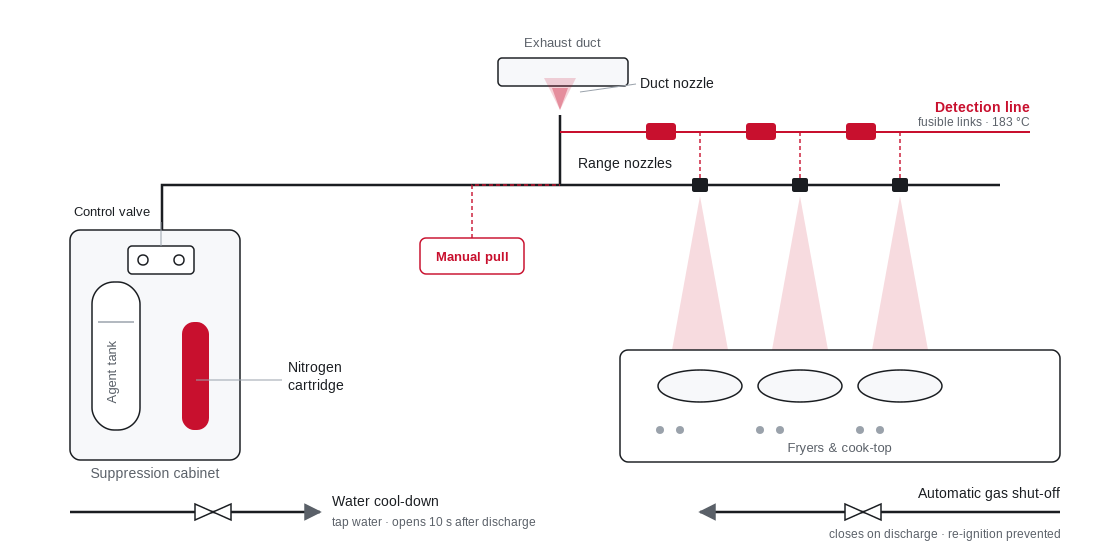
On a full cook line the fire is rarely in one pan — it spreads through the hood, into the grease-laden duct, and back down onto every burner still running. The CMJS18-2 is built for that sequence: 18 L of agent, one cabinet, five actions running in parallel.
1 · Detect at 183°C
A fusible link above every hazard unit and duct opening. At 183°C the link separates and releases the mechanical actuator — no electronics in the trip path, no false trips from steam or smoke.
2 · Discharge in 3–5 s
Both 9 L tanks feed the same nozzle network, delivering 18 L of wet chemical as a fine mist. Steady pressure means hot oil stays in the pan instead of being thrown across the line.
3 · Cut the gas
The gas shut-off valve closes on the incoming line at the same moment, cutting fuel to every burner on the protected line — the step that stops re-ignition.
4 · Alarm and notify
Local sounder and beacon, plus a dry contact to the fire panel or BMS. In a hotel or a mall, the control room knows the kitchen before the first person reaches the door.
5 · Cool with water
Roughly 10 seconds after the agent, the water valve opens and cools the range and duct. Without this stage a wok battery can re-flash while staff are still evacuating.
Backup · Manual pull
A pull station at the kitchen exit and an emergency button on the cabinet, both using the same discharge path as automatic activation.
One cabinet, eighteen units
The alternative to a CMJS18-2 is usually two CMJS9-1 cabinets — and that difference shows up long after the purchase order.
| Wall space | One 690 × 600 × 200 mm cabinet instead of two separate cabinets, which matters in a kitchen where every metre of wall already has a shelf, a sink or a service riser. |
|---|---|
| Pipework | One nozzle network serving the whole line, instead of two systems running parallel pipework over the same hood. |
| Alarm points | One signal to the fire panel or BMS. Two cabinets mean two interfaces, two sets of terminals and two things to test at acceptance. |
| Gas shut-off | A single interlock closing the line feed for the whole cook line, rather than coordinating two valves on the same gas run. |
| Service | One inspection visit, one set of fusible links, one spare-parts list. In a chain, that difference multiplies across every site. |
| Refill | 18 L of agent in one event rather than two 9 L tanks that must be refilled separately after a discharge. |
The trade-off is honest: an 18-2 costs more than a single 9-1 up front. It pays back when the kitchen is genuinely running 10 units or more, or when the layout leaves no second wall position for another cabinet.
Typical layouts we size for
| Hotel banquet kitchen · 12–18 units | Wok battery plus roasting and stock ranges over a long hood, with two or three duct openings. One CMJS18-2 covers the line from a single cabinet position. |
|---|---|
| Chain restaurant · 10–14 units | Standardised line replicated across sites. Sizing stays identical from store to store, which simplifies procurement and staff training. |
| Central kitchen · 18+ units | Two or more CMJS18-2 cabinets, each zoned to one cooking block, so a discharge in one block does not take the whole facility offline. |
| Hospital or university canteen · 8–16 units | Long serving line with mixed appliances. Duct protection usually decides the count here rather than the burners. |
| QSR · 6–9 units | Usually a CMJS9-1, but an 18-2 leaves headroom if a second fryer bank is planned within two years. |
If your layout is not on this list, it is not unusual — send the plan and we will size it from scratch. Sizing is free and returns in one working day.
Where the CMJS18-2 stands on standards
The local standard decides what you are permitted to install, so it is better to settle this before the design is frozen than after the system lands.
| China — GA 498-2012 | Design, installation and acceptance standard for commercial kitchen cooking-area suppression. The CMJS18-2 is CCCF certified and type-tested by the National Fixed Fire Extinguishing Systems Quality Supervision and Testing Centre against this standard. Compare it with NFPA 17A, UL 300 and EN 17446. |
|---|---|
| United States — NFPA 17A / UL 300 | This model is not UL listed. If your project is specified to UL 300, raise it at inquiry stage and we will confirm exactly what documentation the factory can provide before you commit. |
| Europe — EN 16282 / local codes | European projects usually require CE marking under the applicable harmonised standard. This model does not carry CE marking; treat it as a China-standard system unless your consultant accepts CCCF documentation. |
| Middle East, Africa, Southeast Asia, Latin America | Projects in these markets commonly accept a CCCF-certified system with a full type-test report. This is where the CMJS18-2 is most often supplied. |
Certificates, type-test reports and the manufacturer’s ISO 9001 / 14001 / 45001 documents are collected on the certifications page, and ship as a PDF pack with every quotation. For the engineering background, read how a kitchen fire suppression system works.
Buyer questions on the CMJS18-2
How do I know whether I need 9 or 18 hazard units?
Is the CMJS18-2 just two CMJS9-1 systems in one box?
Does it work during a power failure?
Can it go into an existing kitchen?
What is replaced after a discharge?
How is it maintained across a chain?
What do you need to quote?
Send your kitchen layout — we size it free
Upload a plan or just count your appliances; our engineers return a system layout and quotation within 24 hours.
Start an Inquiry